Ecommerce Business Models: The Complete Guide (With the Numbers Most Guides Skip)

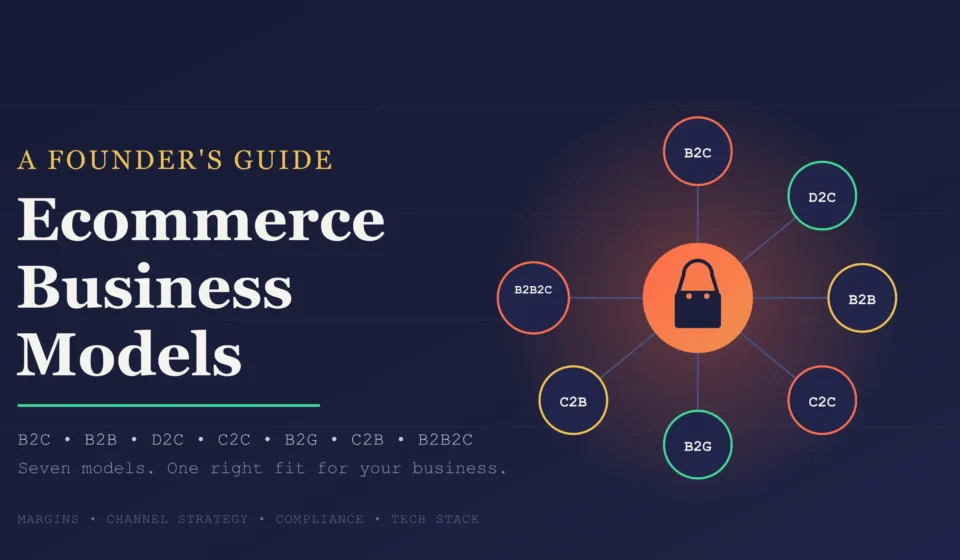
Picking an ecommerce business model isn’t a launch-day checkbox. It decides your margins, your tax exposure, your tech stack, and how fast you can actually grow. Most guides stop at definitions — B2C sells to consumers, B2B sells to businesses, and so on. That’s the easy 20%.
This guide covers the 7 core models too, but spends most of its time on what actually moves the needle: real unit economics, how to run two models at once without your channels fighting each other, the tax and legal landmines nobody mentions, and the tech stack each model actually needs.
The 7 Ecommerce Business Models, Fast
| Model | Sells To | Typical Margin | Typical CAC | Sales Cycle |
|---|---|---|---|---|
| B2C | Individual consumers | 20–40% | $30–$80 | Minutes |
| B2B | Other businesses | 15–35% (higher AOV) | $500–$3,000+ | Weeks–months |
| D2C | Consumers, no middleman | 40–65% | $40–$120 | Minutes–hours |
| C2C | Peer-to-peer marketplaces | 10–20% (platform fee) | Low (platform-driven) | Minutes |
| C2B | Individuals selling to businesses | Variable, project-based | N/A | Days–weeks |
| B2G | Government agencies | 10–25%, very stable | High (bid/RFP cost) | Months–years |
| B2B2C | Businesses via a partner, to consumers | 15–30% (shared) | Low (partner-driven) | Weeks |
These figures are directional industry ranges, not guarantees — your actual numbers depend on category, geography, and execution. But notice what neither BigCommerce nor SellersCommerce gives you: a number to actually plan around. “Higher margins” doesn’t help you build a budget. A 40–65% D2C margin range does.
The real takeaway: D2C wins on margin but loses on CAC — you’re paying for both the marketing and the fulfillment infrastructure a retailer would otherwise absorb. B2B wins on order value but demands patience and a CRM-heavy sales motion. C2C wins on speed-to-first-sale but caps your margin at whatever the platform doesn’t take.
Running Two Models at Once: The Hybrid Playbook
Almost every growing brand ends up hybrid — D2C plus wholesale, or B2C plus a B2B arm for bulk buyers. Articles mention this happens; few explain how to do it without your channels undercutting each other.
1. Separate your pricing logic before you separate anything else. If your D2C price and your wholesale price are visible to the same customer, you’ll train people to wait for a discount or go around your retail partners. Use tiered pricing tools or a separate storefront (password-protected B2B portal, or a platform with role-based pricing) so a wholesale buyer never sees your retail price page.
2. Decide who owns inventory conflict resolution. When a wholesale partner and your D2C store are both selling the same SKU, somebody needs the authority to say “D2C gets priority during a flash sale” or “wholesale orders are guaranteed fulfillment within 48 hours regardless of D2C demand.” Without a documented rule, this becomes a recurring fire drill.
3. Expect channel conflict — and put it in writing. Retail partners get uneasy when your D2C price beats their shelf price. The standard fix is a MAP (Minimum Advertised Price) policy: you can sell direct, but you commit to not advertising below an agreed floor. MAP governs advertised price, not the final checkout price, so it leaves room for private discounts without devaluing the brand publicly. Build this into your wholesale contracts from day one, not after a partner complains.
4. Your tech stack needs to talk to itself. Running B2B and B2C on two disconnected systems means double inventory entry and stock mismatches. At minimum, your order management or ERP layer needs to sit above both storefronts so stock levels sync in real time.
What Nobody Tells You About Tax, Legal, and Compliance by Model
This is the gap that costs real money, and it’s almost entirely absent from existing guides.
- C2C / marketplace selling: Selling on Etsy, eBay, or Amazon doesn’t exempt you from sales tax nexus entirely. Most marketplaces now collect and remit tax on your behalf under marketplace facilitator laws, a wave of state legislation that followed the 2018 South Dakota v. Wayfair ruling — but once you also sell direct through your own site, nexus rules apply separately to that revenue, and thresholds vary by state.
- D2C cross-border: Selling internationally direct-to-consumer means dealing with VAT/GST registration, customs duties, and potentially needing a local merchant-of-record partner to avoid becoming legally liable in every country you ship to.
- B2B: Resale certificates matter — if you’re selling to a business that will resell your product, you may not need to collect sales tax on that transaction, but you need the paperwork on file or you’re exposed in an audit.
- C2B (freelance/contractor models): If your business pays individuals through a C2B model (commissioning content, design, or services), worker classification matters. The U.S. Department of Labor’s economic reality test weighs factors like control, permanence, and opportunity for profit or loss — and several states apply a stricter “ABC test” on top. Misclassifying a contractor is a common, expensive mistake.
- B2G: Government contracts come with their own compliance layer — data security standards, accessibility requirements, and strict procurement rules that don’t apply to any other model on this list.
None of this is legal advice — consult a tax professional or attorney before structuring a hybrid or cross-border model. But knowing which questions to ask your advisor, by model, is the part most guides skip entirely.
Matching Your Tech Stack to Your Model
A B2C store and a B2B operation cannot run well on the same default setup. Here’s the mapping most “platform comparison” articles never make explicit:
| Model | What the stack must handle | Common tools |
|---|---|---|
| B2C / D2C | Fast checkout, mobile conversion, personalization | Shopify, BigCommerce, headless storefronts |
| B2B | Tiered/negotiated pricing, bulk ordering, punchout/EDI, approval workflows | B2B-specific platforms, ERP integration |
| C2C / Marketplace | Seller onboarding, dispute resolution, payment escrow | Marketplace-specific SaaS, Stripe Connect |
| Subscription | Dunning management, churn prediction, flexible billing cycles | Recharge, Chargebee |
| B2G | Procurement portal compatibility, accessibility compliance | Custom builds, SAP Ariba-compatible systems |
If you pick a generic SaaS cart and bolt on B2B later, you’ll hit a wall around tiered pricing and approval workflows — these aren’t typically native features, they’re add-ons or full re-platforms.
A Decision Framework With Actual Thresholds
Most existing advice says “consider your audience” and “know your costs” without giving you a number to act on. Here’s a sharper version:
- If your gross margin is under 15%, avoid pure dropshipping — thin margins plus dropshipping’s already-thin margins compound into an unsustainable business once you add ad spend.
- If your average order value is under $30, B2B isn’t worth pursuing yet — the sales effort per deal won’t justify the revenue.
- If you have under $5,000 in starting capital, C2C marketplaces or dropshipping are realistic; private label or wholesale generally aren’t, because they require upfront inventory investment.
- If your product needs explanation or demonstration to sell (complex software, high-involvement purchases), C2B/direct-selling-style personal engagement outperforms a pure self-serve storefront.
- If you’re already selling wholesale and considering D2C, model the MAP conflict before launch, not after your first angry retailer email.
Models and Trends Most Guides Miss Entirely
Retail media as a revenue layer. Beyond the core business model, many ecommerce businesses now run retail media — selling ad placements on their own site or marketplace listings to other brands. US retail media ad spend is projected to reach roughly $71 billion in 2026, with Amazon’s and Walmart’s networks leading the way. It’s not a standalone “model,” but it changes the margin profile of marketplace and B2C businesses meaningfully.
Print-on-demand as distinct from generic dropshipping. Print-on-demand shares dropshipping’s no-inventory structure but differs in customization and brand control — worth separating out if you’re evaluating low-capital entry points.
Agentic commerce. AI shopping agents are starting to research, compare, and complete purchases on a consumer’s behalf through emerging standards like the Universal Commerce Protocol and merchant-redirect flows in tools like ChatGPT and Google AI Mode. McKinsey estimates agentic AI could influence $3–5 trillion in global retail commerce by 2030. Early movers are optimizing product feeds and structured data specifically for AI agent readability, not just human browsing — a shift that will matter more through 2026 and beyond, though best practices are still forming.
B2E (business-to-employee). Company stores, branded merchandise programs, and internal ordering portals are a real, named ecommerce model used heavily in the promotional products and corporate gifting space — distinct from B2B because the “buyer” is an employee operating within a budget/approval system, not a purchasing department negotiating price.
Choosing Your Model: The Short Version
- Get clear on your starting capital and risk tolerance — this eliminates more options than audience research does.
- Match your product type (physical, digital, service) to a model that fits its delivery economics.
- Model your tax and compliance exposure before you pick a hybrid structure, not after.
- Choose a platform that supports your model’s pricing and workflow needs natively — re-platforming later is expensive.
- Revisit annually. Most successful ecommerce businesses change or add a model within 2–3 years of launch.
There’s no universally “best” ecommerce business model. There’s only the one that matches your capital, your product, and your appetite for operational complexity — backed by numbers you actually checked, not just a gut feeling.