

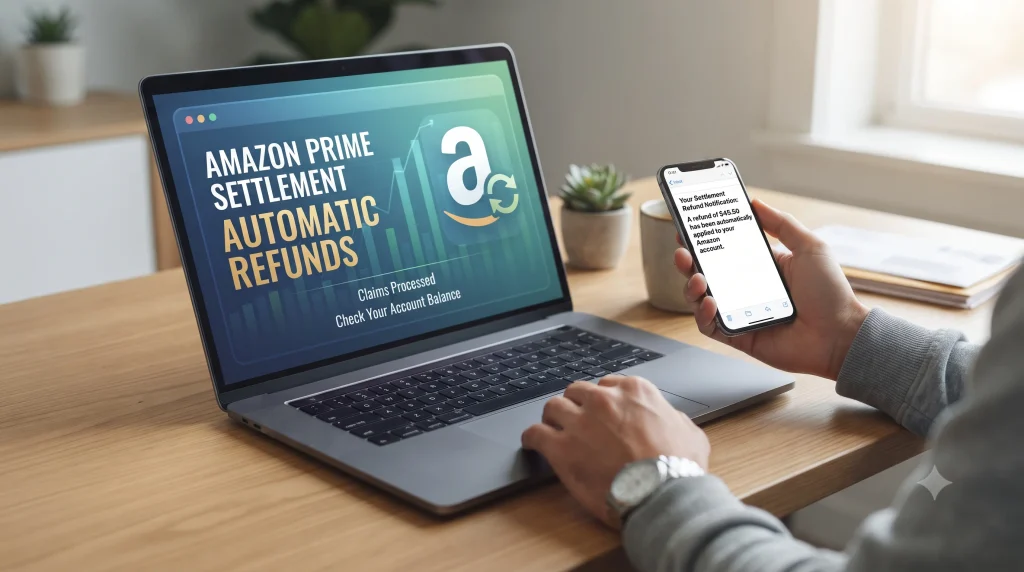
If you’ve ever signed up for Amazon Prime and later found it frustratingly hard to cancel, you may be one of millions of consumers now in line for money back. The Amazon Prime settlement automatic refunds program, run under the supervision of the Federal Trade Commission (FTC), has just been expanded — and it’s about to reach far more people than before.
In September 2026, the FTC announced that a federal court approved sweeping changes to the redress order tied to its record-breaking case against Amazon. Under the revised terms, the maximum payout jumped from $51 to $200, millions of additional Prime members became eligible, and — most importantly — every future payment will be sent out automatically, with zero paperwork required from consumers.
This article breaks down exactly what the Amazon Prime settlement automatic refunds initiative is, who qualifies, how much money is on the table, when payments arrive, and how to protect yourself from scammers trying to exploit the news. Whether you’re wondering if you’re owed money or simply want to understand the mechanics of this consumer protection case, this guide covers every angle.
Background: How the Amazon Prime Settlement Began
To understand the current wave of Amazon Prime settlement automatic refunds, it helps to know how the case started. In September 2025, the FTC secured a historic $2.5 billion settlement against Amazon, resolving allegations that the company had enrolled millions of consumers into Prime subscriptions without clear consent and then made the cancellation process needlessly complicated — a practice sometimes referred to as a “dark pattern” in digital design.
As part of that original agreement, Amazon was required to:
- Pay a $1 billion civil penalty to the federal government.
- Set aside up to $1.5 billion in redress payments for consumers who were harmed by the deceptive enrollment and cancellation practices.
- Simplify its Prime sign-up and cancellation flow going forward.
By September 2026, Amazon had already issued more than $845 million of that redress fund to eligible customers. But a large group of consumers — those who had used a moderate number of Prime benefits — were still excluded from the original payment structure. That’s where the newly revised order, and the expanded Amazon Prime settlement automatic refunds rollout, comes in.
What Changed in the Revised FTC Order
According to the FTC’s official announcement, a federal court approved a joint motion from the FTC and Amazon in September 2026 that significantly reshapes the redress program. There are three major updates worth understanding:
1. A Higher Payment Cap
The original settlement capped individual refunds at $51. Under the revised order, that ceiling has nearly quadrupled to $200 per eligible consumer. This change alone is one of the biggest reasons the Amazon Prime settlement automatic refunds story has resurfaced in the news this fall.
2. A Broader Pool of Eligible Consumers
Previously, only consumers who used fewer than 10 Prime benefits (like Prime Video, Prime Music, or fast shipping) during a 12-month period qualified for redress. The revised order extends eligibility to consumers who used between 11 and 20 Prime benefits in a one-year window — a group that had been left out of earlier payment phases entirely.
3. Fully Automatic Payments
Perhaps the most consumer-friendly change is that all future payments under the Amazon Prime settlement automatic refunds program will be issued without any action required from consumers. There’s no claim form, no online portal to visit, and no deadline to submit documentation. If you qualify, Amazon sends the money directly.
You can read the FTC’s full announcement on its official press release page, which outlines the legal basis for these changes in detail.
Who Qualifies for Amazon Prime Settlement Automatic Refunds
Eligibility for the Amazon Prime settlement automatic refunds program is based on three specific criteria. According to reporting that cites the FTC’s guidance, a consumer generally qualifies if they meet all of the following conditions:
- Location: You must be an Amazon Prime customer based in the United States.
- Enrollment or cancellation history: You either enrolled in Prime through one of the sign-up flows the FTC challenged as deceptive, or you attempted — and struggled — to cancel your Prime membership through Amazon’s online cancellation process, at any point between June 23, 2019, and June 23, 2025.
- Limited benefit usage: You used no more than 20 Prime benefits (such as Prime Video streaming, Prime Music, or two-day shipping) during any 12-month period following your enrollment.
If all three boxes are checked, you’re likely part of the newly expanded group receiving Amazon Prime settlement automatic refunds starting in October 2026. Notably, you do not need to apply, register, or prove anything — Amazon’s own account records are used to determine eligibility and calculate what you’re owed.
It’s worth emphasizing that this program specifically targets people who were relatively light users of Prime perks. The logic behind the FTC’s approach is straightforward: someone who barely used Prime Video, Prime Music, or free shipping may not have gotten meaningful value from the subscription, which supports the claim that they were enrolled without real intent or were unable to easily cancel.
How Much Money Can You Get?
The dollar amounts involved in the Amazon Prime settlement automatic refunds program have shifted significantly since the original 2025 settlement. Here’s how the numbers break down:
- Original cap: $51 per eligible consumer, for those who used fewer than 10 Prime benefits in a year.
- New expanded group: Consumers who used 11–20 Prime benefits in a 12-month window will now receive automatic payments starting October 1, 2026.
- New maximum total: $200 per consumer, once all phases of payment are complete.
- Supplemental payment: If overall consumer participation in accepting payments doesn’t hit a required threshold by February 2027, Amazon will issue an additional automatic payment of up to $149 to consumers who already received an earlier payment — bringing their running total to as much as $200.
This means the Amazon Prime settlement automatic refunds program isn’t necessarily a single lump-sum event for everyone. Some consumers may receive one payment now and a second, supplemental payment later, depending on how the overall fund distribution plays out. The FTC has said this second round of top-up payments, if triggered, will begin no later than April 2027.
Timeline: When Will Payments Arrive?
Timing is one of the most searched aspects of the Amazon Prime settlement automatic refunds story, and for good reason — knowing when to expect money helps consumers plan and also helps them spot fraudulent “early access” scams. Here’s the confirmed schedule:
- October 1, 2026: Amazon begins issuing automatic refunds to the newly expanded group of consumers who used 11–20 Prime benefits during a qualifying 12-month period.
- By February 2027: The FTC and Amazon will evaluate whether enough consumers have accepted their payments to meet the settlement’s redress threshold.
- By April 2027: If the threshold isn’t met, Amazon will begin sending supplemental payments of up to $149 to consumers who already received an earlier refund, completing the path to a $200 total payout.
Because this rollout happens in phases, not everyone will see a payment land in their account on the exact same day. If you fall into the newly eligible group, keep an eye on your bank, PayPal, Venmo, or mailbox starting the first week of October 2026.
How the Automatic Refund Process Actually Works
A defining feature of the Amazon Prime settlement automatic refunds program is that it removes the burden of paperwork entirely. Here’s what that looks like in practice:
- No claim forms. Unlike many class-action settlements that require consumers to file a claim before a deadline, this program pays eligible consumers without any submission required.
- No notices to respond to. You won’t need to confirm your identity or respond to an email or letter to “activate” your refund.
- Direct payment methods. Amazon is distributing funds via Venmo, PayPal, or a mailed paper check, depending on the payment information already associated with your account.
- 60-day acceptance window. Once a payment is issued, consumers are generally advised to accept or cash it within 60 days of the issue date to avoid it expiring or being returned.
This “no claims needed” structure is a significant departure from how many corporate settlements are typically administered, and it’s a big part of why the Amazon Prime settlement automatic refunds program has generated so much consumer interest. The FTC has framed this as a deliberate design choice meant to maximize how many harmed consumers actually receive money, rather than losing a chunk of the fund to unclaimed payments.
Why the FTC Expanded the Settlement
The decision to broaden the Amazon Prime settlement automatic refunds program wasn’t arbitrary. According to Christopher Mufarrige, Director of the FTC’s Bureau of Consumer Protection, the revised order exists to make sure more consumers who were harmed by Amazon’s enrollment and cancellation practices actually benefit from the settlement, rather than falling through gaps in the original structure.
This reflects a broader trend in FTC enforcement: rather than treating a settlement as a one-time, static event, the agency is increasingly willing to revisit redress programs and adjust them when data shows large groups of affected consumers were left out. In this case, the consumers who used 11 to 20 Prime benefits annually represented a substantial population that the original $51 cap and narrower eligibility window didn’t reach.
For readers who want the full legal and regulatory context, the FTC maintains a dedicated Amazon refunds information page that is updated as new phases of payment roll out.
Amazon Prime Settlement Automatic Refunds: Watch Out for Scams
Whenever a major refund program makes headlines, scammers follow closely behind. The FTC has issued explicit warnings tied to the Amazon Prime settlement automatic refunds rollout, and consumers should keep the following points in mind:
- The FTC will never contact you directly about this refund. If you get a call, text, or email claiming to be from the FTC about your Amazon Prime payment, it is almost certainly a scam.
- Amazon will never ask you to pay a fee to receive your refund. Any message asking for payment, gift cards, or personal banking details “to release” your refund should be treated as fraudulent.
- No one can guarantee a bigger payout or “priority processing” in exchange for money or personal information. Genuine payments are calculated automatically using your existing Amazon account history.
- Verify independently. If you’re unsure whether a message about your refund is legitimate, go directly to the FTC’s official refund page rather than clicking links in an unsolicited email or text.
Because the entire point of the Amazon Prime settlement automatic refunds program is that no action is required from consumers, any message asking you to “click here to claim” or “verify your account” to receive payment should raise immediate red flags.
What If You Think You Were Missed?
Since payments under the Amazon Prime settlement automatic refunds program are issued automatically based on account records Amazon already has, there’s no application process to worry about. However, if the October 1, 2026 payment cycle passes and you believe you meet all three eligibility criteria but haven’t received anything, here are reasonable next steps:
- Check your Amazon account’s payment and contact information to make sure it’s current, since outdated payment details can delay a mailed check or a Venmo/PayPal transfer.
- Monitor the FTC’s Amazon refunds page for updates on additional payment phases, since the rollout is happening in stages through at least April 2027.
- Be patient with mailed checks, which can take longer to arrive than electronic payments.
- Avoid third-party “refund recovery” services that claim they can speed up or guarantee your payment for a fee — these are not affiliated with the FTC or Amazon and are often scams themselves.
Amazon Prime Settlement Automatic Refunds: Quick Reference Table
| Detail | Information |
|---|---|
| Total settlement value | $2.5 billion |
| Consumer redress fund | Up to $1.5 billion |
| Civil penalty to the government | $1 billion |
| Amount already paid out (as of Sept. 2026) | $845 million+ |
| Original payment cap | $51 |
| New payment cap | $200 |
| Newly eligible group | Consumers who used 11–20 Prime benefits annually |
| New payments begin | October 1, 2026 |
| Supplemental payments (if needed) | Up to $149, starting by April 2027 |
| Payment methods | PayPal, Venmo, or mailed check |
| Claim required? | No — fully automatic |
Why This Case Matters Beyond Amazon
The Amazon Prime settlement automatic refunds program isn’t just a story about one company writing checks — it’s a signal of how regulators are approaching subscription-based businesses more broadly. Over the past several years, the FTC has grown increasingly focused on so-called “negative option” subscriptions, where a service automatically renews or is difficult to cancel unless a consumer takes deliberate action. Amazon’s case became one of the most high-profile examples of this scrutiny, precisely because of Prime’s massive scale and its deep integration into everyday online shopping habits.
For consumers, the expansion of the Amazon Prime settlement automatic refunds program offers a useful reminder to periodically review recurring subscriptions and understand exactly what a cancellation process looks like before signing up. For businesses, the case serves as a cautionary tale: regulators are willing to revisit settlements, expand eligibility, and increase penalties well after an initial agreement is finalized if evidence suggests consumers are still being underserved.
It’s also worth noting that the FTC’s approach to distributing these funds — automatic, no-claim payments — is likely to influence how future large-scale consumer settlements are structured. Traditional class-action settlements often see claim rates in the single digits or low double digits, meaning large portions of a settlement fund can go unclaimed. By removing that friction entirely, the Amazon Prime settlement automatic refunds program is positioned to return money to a far larger share of the consumers who were actually harmed, rather than leaving millions of dollars unclaimed on the table.
Frequently Asked Questions
Do I need to file a claim to get my Amazon Prime refund? No. The entire point of the Amazon Prime settlement automatic refunds program is that eligible consumers receive payment automatically, with no forms, claims, or notices required.
How will I actually receive the money? Amazon distributes payments via Venmo, PayPal, or a mailed paper check, depending on the information tied to your account.
What’s the maximum I could receive? Under the revised order, the maximum total payout is $200 per eligible consumer, up from the original $51 cap.
When do payments start? The newly expanded group began receiving automatic refunds starting October 1, 2026, according to reporting on the FTC’s updated guidance.
Is this refund program legitimate? Yes. It stems directly from a $2.5 billion FTC settlement with Amazon over Prime enrollment and cancellation practices. However, be cautious of scammers impersonating the FTC or Amazon in connection with these payments.
What if I used more than 20 Prime benefits in a year? Based on current eligibility rules, consumers who used more than 20 Prime benefits in any 12-month period are not included in this phase of the Amazon Prime settlement automatic refunds program.
Final Thoughts
The expansion of the Amazon Prime settlement automatic refunds program marks a significant moment in one of the largest consumer protection cases the FTC has ever brought. By raising the payment cap to $200, widening eligibility to millions of additional Prime members, and removing the claims process entirely, regulators have made it far easier for everyday consumers to actually receive the compensation they’re owed.
If you were a Prime member between June 2019 and June 2025 and used a limited number of Prime benefits during that time, there’s a good chance you’re part of this expanded group. You won’t need to do anything but watch your PayPal, Venmo, or mailbox starting in October 2026 — and stay alert for scammers trying to piggyback on the news. As this remains an active, multi-phase settlement, checking the FTC’s official refund page periodically is the safest way to stay updated on your Amazon Prime settlement automatic refunds status through 2027.