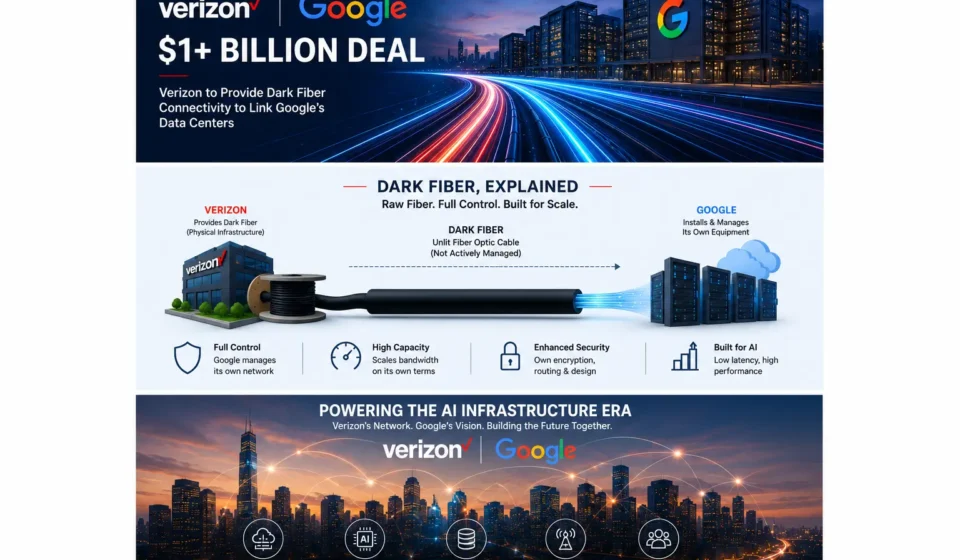

On July 24, 2026, Verizon confirmed one of the most talked-about telecom stories of the year: the Verizon Google billion dollar deal. Announced by CEO Dan Schulman during Verizon’s second-quarter earnings call, the agreement will see Verizon supply dark fiber connectivity to link Google’s data centers, in a contract reportedly worth more than $1 billion. For an industry watching every move hyperscalers make to feed their AI ambitions, the Verizon Google billion dollar deal is more than a headline — it’s a signal of where telecom revenue is heading next.
If you’ve been following the news cycle, you’ve probably already seen the basic facts repeated across financial outlets: Verizon signed a deal, it’s worth over $1 billion, and it involves Google’s data centers. What most coverage hasn’t done is explain why this deal is happening now, what dark fiber actually means for both companies, and what it tells us about the next phase of the AI infrastructure buildout. This article breaks down the entire story — the announcement itself, the technology behind it, the financial backdrop at both companies, and what to expect next.
What Is the Verizon Google Billion Dollar Deal, Exactly?
At its core, the Verizon Google billion dollar deal is an infrastructure agreement, not a merger, acquisition, or equity partnership. Verizon will provide Google with dark fiber — physical fiber-optic cable that Google will operate using its own networking equipment — to connect its data center facilities. Schulman disclosed the arrangement on Verizon’s post-earnings call, telling investors the agreement was valued at more than $1 billion.
Crucially, neither company has released full details about the contract’s duration, its geographic footprint, or the deployment timeline. That lack of specificity hasn’t stopped the market from reacting: Verizon’s stock jumped more than 3% in Friday’s opening trade, while Alphabet’s Class A shares rose roughly 1%, with VZ trending as one of the most discussed tickers on retail trading platforms that morning.
What makes the Verizon Google billion dollar deal notable isn’t just the dollar figure — it’s what it represents. Schulman called the announcement “consequential,” describing it as a preview of what Verizon’s future revenue growth will look like. In his words, the buildout of AI infrastructure across the United States is “one of the largest capital cycles of our lifetime,” and Verizon believes it’s “uniquely positioned to participate in it.”
Dark Fiber, Explained: The Technology Behind the Headlines
Most coverage of the Verizon Google billion dollar deal mentions “dark fiber” without explaining what it actually means — which leaves readers with half the picture. Here’s the plain-English version.
Fiber-optic cable that has been laid but isn’t yet “lit up” with active networking equipment is called dark fiber. When a telecom company like Verizon leases dark fiber to a customer, it isn’t providing an internet connection in the traditional sense — it’s leasing the raw physical infrastructure. The customer, in this case Google, installs and manages its own equipment on that fiber, giving it complete control over capacity, encryption, routing, and network design.
This is fundamentally different from a managed network service, where the telecom provider handles the equipment, monitoring, and maintenance on the customer’s behalf. For a company like Google, which operates some of the largest and most latency-sensitive computing networks in the world, dark fiber offers a level of customization and control that a managed service simply can’t match. It also allows Google to scale capacity on its own terms as AI workloads grow, without waiting on a third party to provision additional bandwidth.
For Verizon, leasing dark fiber is an efficient way to monetize existing long-haul and metro fiber assets — infrastructure that was originally built for a different era of telecom demand — without having to build and operate new active network services. Schulman made this point directly on the earnings call, describing Verizon’s carrier-grade transport network as “exactly the right asset” for connecting AI data centers, compute clusters, and regions.
Why This Deal Is Happening Now
To understand the timing of the Verizon Google billion dollar deal, you have to look at what’s happening on Google’s side of the table. Alphabet, Google’s parent company, reported negative free cash flow of approximately $5.9 billion in its second quarter — the company’s first negative free cash flow quarter since it went public in 2004. That’s a striking number for one of the most profitable companies in the world, and it reflects just how aggressively Alphabet is spending to build out AI infrastructure.
Alphabet didn’t just absorb that cash flow hit quietly — it raised its full-year 2026 capital expenditure guidance to a range of $195 billion to $205 billion, up from a prior forecast of $180 billion to $190 billion. The bulk of that spending is earmarked for servers, data centers, and networking equipment, the exact category of infrastructure the Verizon Google billion dollar deal falls under. Alphabet has also signaled it will lean more heavily on third-party compute capacity as a bridge while it continues expanding its own infrastructure internally.
In other words, the Verizon Google billion dollar deal isn’t an isolated transaction — it’s a direct byproduct of the AI capital expenditure race among hyperscalers. Google needs more physical connectivity between its data centers to support AI training and inference workloads, and Verizon has fiber assets sitting idle that are perfectly suited to that need. The deal is less a “partnership announcement” in the traditional PR sense and more a straightforward supply-and-demand match created by the AI infrastructure boom.
Verizon’s Bigger Strategic Bet: Becoming an AI Infrastructure Company
The Verizon Google billion dollar deal is best understood as one piece of a larger strategic pivot at Verizon, not a standalone win. Schulman was explicit about this on the earnings call, telling investors that the Google agreement is “only the beginning” of Verizon’s push into AI infrastructure connectivity.
According to Schulman, Verizon expects to announce additional agreements by the end of 2026 that, taken together, are projected to generate multiple billions of dollars in revenue over the next several years. He described these upcoming deals as long-duration, high-quality revenue streams sourced from some of the world’s most demanding infrastructure customers — a description that strongly implies more hyperscalers and AI compute providers are already in the pipeline.
Verizon is also repurposing existing physical assets to capture this demand. The company is converting a number of its central offices — legacy facilities originally built for wireline telephone service — into inference edge data centers. Verizon is reportedly already in discussions with potential partners interested in using these power-ready sites, which could extend the company’s AI infrastructure ambitions well beyond fiber leasing into edge computing capacity itself.
“We expect this initiative to noticeably contribute to our revenue growth starting next year and to grow substantially from there,” Schulman said, underscoring that the Verizon Google billion dollar deal is meant to be a template, not an exception.
This strategy places Verizon alongside a growing list of telecom and infrastructure companies — including AT&T, Lumen Technologies, and others — that are repositioning legacy fiber networks as critical infrastructure for the AI era. Where telecoms once competed primarily on consumer wireless plans and home broadband, a new, higher-margin revenue category is emerging: selling connectivity directly to the hyperscalers building the AI economy.
The Financial Backdrop: Verizon’s Q2 2026 Earnings
The Verizon Google billion dollar deal landed in the middle of a broader earnings report that gave investors plenty to digest. Verizon posted second-quarter earnings per share of $1.30 on revenue of $34.3 billion. That EPS figure beat Wall Street’s expectation of $1.27, though revenue came in slightly below the $35.1 billion analysts had forecast.
Despite the revenue miss, Verizon raised its full-year EPS guidance to a range of $4.99 to $5.04, up from its prior guidance of $4.95 to $4.99, and above the $4.94 Wall Street had penciled in. The company also expanded its full-year share repurchase target to as much as $4.5 billion, after already buying back $3.5 billion in stock during the first half of the year.
Schulman framed the quarter as evidence of operational discipline, noting that lower customer churn combined with stronger unit economics had produced “the strongest operating position we have seen in years.” Verizon also added 184,000 wireless subscribers during the quarter, a sign that its core consumer business remains stable even as the company pursues new growth avenues like the Google fiber agreement.
Put together, the Verizon Google billion dollar deal and Verizon’s broader Q2 results tell a consistent story: a company using a healthy core business as a foundation to fund and support its expansion into AI infrastructure connectivity, a market it sees as a major new growth engine for the years ahead.
Market Reaction and Investor Sentiment
Investors responded quickly and favorably to the news. Verizon (NYSE: VZ) shares rose more than 3% in early Friday trading following the announcement, while Alphabet (NASDAQ: GOOGL) shares ticked up roughly 1%. Verizon was among the most actively discussed stocks on retail trading platforms that morning, with sentiment leaning bullish.
Zooming out, Verizon stock is up approximately 11% year-to-date as of the announcement, a solid performance for a legacy telecom operator in a market where growth stocks tend to dominate headlines. The Verizon Google billion dollar deal appears to have reinforced a narrative that’s been building among investors: that Verizon’s fiber assets have untapped value as AI infrastructure demand accelerates, and that the company’s long-standing network investments could translate into a meaningful new revenue stream.
For a full breakdown of the announcement as it broke, <cite index=”1-1″>Verizon CEO Dan Schulman said the company will provide dark fiber to connect Google’s data centers</cite> during the Q2 2026 earnings call coverage on Yahoo Finance, which also detailed the immediate stock market reaction. Reuters’ original wire report, syndicated across financial outlets including US News, confirmed the core deal terms directly from Schulman’s on-call remarks. A more technical breakdown of what dark fiber leasing means for hyperscaler data center connectivity was also covered by Blockspace Media.
What Wasn’t Disclosed — And Why It Matters
One aspect of the Verizon Google billion dollar deal that deserves more attention than it has received is what remains unknown. Neither Verizon nor Google has disclosed the contract’s exact duration, the specific regions or data center campuses involved, or a deployment schedule. This is fairly typical for infrastructure agreements of this size, where competitive and operational sensitivities often keep granular details out of public statements, but it does leave several open questions for anyone trying to fully assess the deal’s impact.
Without a disclosed timeline, it’s difficult to know how quickly this $1 billion-plus figure will convert into recognized revenue for Verizon, or how it will be recognized on the balance sheet — as a multi-year contract, a phased build-out, or a combination of upfront and recurring payments. Given Schulman’s comment that the initiative should “noticeably contribute” to revenue growth starting next year, a multi-year structure with early cash flow appears most likely, but that remains an informed inference rather than a confirmed fact.
It’s also worth noting that the geographic scope hasn’t been confirmed. Google operates data centers across dozens of U.S. states and multiple countries, and Verizon’s long-haul and metro fiber network has different levels of density depending on region. Until more details emerge, investors and industry watchers are left extrapolating from Verizon’s known infrastructure footprint rather than confirmed deployment plans.
What Comes Next: More Deals on the Horizon
Perhaps the most forward-looking element of the Verizon Google billion dollar deal is what Schulman said about the future. He confirmed that Verizon expects to announce additional infrastructure agreements before the end of 2026, and that these deals — combined — are projected to be worth multiple billions of dollars in revenue over the coming years.
Schulman did not name the companies involved in these upcoming deals, but given the context, it’s reasonable to expect other major cloud providers or AI compute companies to be part of the pipeline. Amazon Web Services, Microsoft Azure, Meta, and a growing roster of AI-focused compute startups are all in the midst of aggressive data center expansion, and all of them need the same kind of high-capacity fiber connectivity that Google just secured from Verizon.
For investors and industry observers, this makes the coming months worth watching closely. If Verizon follows through with additional multi-billion-dollar infrastructure agreements, the Verizon Google billion dollar deal may end up being remembered less as a singular event and more as the opening move in Verizon’s transformation from a traditional telecom carrier into a core supplier for the AI infrastructure economy.
Taken together, these details paint the Verizon Google billion dollar deal as a rational business decision rather than a splashy PR moment — a straightforward match between Verizon’s underused fiber capacity and Google’s urgent need for more data center connectivity.
Key Takeaways
- The Verizon Google billion dollar deal is a dark fiber connectivity agreement, not an acquisition or equity investment, and it’s worth more than $1 billion.
- Dark fiber gives Google full control over its own networking equipment and capacity, which is critical for connecting data centers running AI workloads.
- The deal comes as Alphabet posts its first negative free cash flow quarter since 2004, driven by a capital expenditure surge to as much as $205 billion for 2026.
- Verizon is repositioning legacy fiber and central-office assets as AI infrastructure, with more billion-dollar-plus deals expected by year-end.
- Verizon’s Q2 2026 earnings beat on EPS, missed slightly on revenue, and came with raised full-year guidance and an expanded stock buyback program.
- Deal duration, geography, and deployment schedule remain undisclosed, leaving some open questions about how quickly the revenue will materialize.
Final Thoughts
The Verizon Google billion dollar deal is a small line item in dollar terms relative to the hundreds of billions hyperscalers are spending on AI infrastructure overall, but its significance goes well beyond the headline number. It marks a clear signal that legacy telecom infrastructure — fiber networks built years or even decades ago for very different purposes — has found new relevance in the AI era. For Verizon, it’s a proof point for a strategy the company is betting will define its next phase of growth. For Google, it’s one piece of the massive infrastructure puzzle needed to keep pace with AI demand.
Whether this becomes a defining trend or a one-off headline will depend largely on what Verizon announces next. Given Schulman’s comments about more deals coming before year-end, the Verizon Google billion dollar deal looks less like an isolated transaction and more like the first confirmed chapter in a much bigger story about how telecom companies are repositioning themselves for the AI infrastructure economy.