
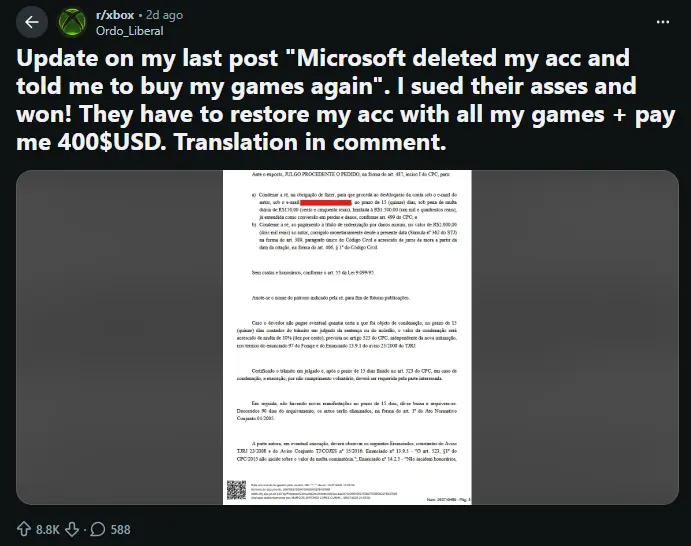

A single Reddit post has turned into one of the more talked-about consumer tech stories of the summer — a Microsoft lawsuit filed by a Brazilian gamer that ended with a court ordering the company to restore a permanently suspended Xbox account, hand back an entire digital game library, and pay damages. It sounds like a small story on the surface: one account, one court, roughly $400 in compensation. But this Microsoft lawsuit has struck a nerve because it lands right in the middle of a much bigger anxiety gamers have been sitting with for years — what actually happens to the games you’ve paid for if a company decides, for whatever reason, that your account no longer exists?
Below is a full breakdown of what happened, what the court actually ordered, why Microsoft fought so hard over a case worth a few hundred dollars, and what this Microsoft lawsuit really does — and doesn’t — mean for the rest of us.
How the Microsoft Lawsuit Started
The story begins with a Reddit user known online as Ordo_Liberal, who noticed his Microsoft account had been flagged for “unauthorized access.” According to the support emails he later shared, Microsoft’s system detected that the account’s security information had changed and treated this as a serious breach. What made the situation unusual is that the account had two-factor authentication switched on the entire time — the exact security measure Microsoft recommends to prevent this kind of incident in the first place.
Instead of a temporary lock while the situation got sorted out, Microsoft treated the suspension as permanent. Support agents told him the account could not be recovered and that if he wanted his games back, he would need to buy them all over again. For a user with years of purchases tied to one account, that wasn’t a minor inconvenience — it meant losing an entire digital library in one move, with no real path back through customer service.
After exhausting Microsoft’s standard recovery channels and getting nowhere, Ordo_Liberal consulted a local attorney and decided to take the matter to court. That decision is what turned a frustrating support ticket into a full-blown Microsoft lawsuit — and it’s the part of the story that other outlets have glossed over. Brazil’s legal system allowed him to pursue the case through small-claims court, a route that doesn’t require paying court costs or hiring an expensive lawyer, under the country’s Consumer Defense Code.
What the Court Actually Ordered
This is where a lot of coverage of the Microsoft lawsuit has stayed vague, so it’s worth spelling out clearly. The ruling gave Microsoft 15 days to unblock the account and restore full access to the digital library. If the company misses that deadline, it faces a daily fine of R$150 (roughly $30), which is capped at a total of R$1,500 (about $300).
Separately, the court awarded the plaintiff R$2,000 — approximately $400 — in what Brazilian law calls “moral damages.” That figure often confuses people when they first hear about this Microsoft lawsuit, because it seems tiny compared to the value of a game library that could easily be worth thousands of dollars. But moral damages in a case like this aren’t meant to reimburse the value of the games themselves — the restoration order already handles that by forcing Microsoft to give the library back. The monetary award instead compensates for the stress, inconvenience, and violation of consumer rights caused by the company’s handling of the dispute. If Microsoft fails to pay that amount on time, an additional 10% penalty gets added on top.
It’s also worth being precise about what kind of ruling this is. This Microsoft lawsuit was decided at the small-claims, first-instance level. It is not binding precedent, it doesn’t automatically apply to other users, and it’s limited entirely to Brazilian jurisdiction. Anyone hoping this sets a global legal standard for digital ownership is getting ahead of the facts — but it’s still a meaningful signal about how courts in consumer-friendly countries might treat similar disputes going forward.
Twelve Lawyers Against One Gamer
One of the more striking details to come out of this Microsoft lawsuit is how seriously the company treated it. Despite the relatively small amount of money at stake, reports indicate Microsoft assigned twelve attorneys to fight the case. That’s a disproportionate response for a dispute worth a few hundred dollars in damages — and it tells you something important about why the company pushed back so hard.
Companies like Microsoft aren’t just worried about paying out $400 to one plaintiff. They’re worried about precedent, even informal precedent, that could encourage thousands of other users to challenge account suspensions the same way. A single small-claims ruling isn’t binding, but a pattern of similar rulings could start shaping how courts — and regulators — view the relationship between digital storefronts and the customers who buy from them. Throwing significant legal resources at a low-value case is a fairly common corporate strategy for containing that kind of risk before it spreads.
What’s Really at Stake in a Suspended Microsoft Account
Part of what makes this Microsoft lawsuit resonate is that a Microsoft account isn’t just an Xbox login. It’s a single identity tied to a wide range of paid products and services: Xbox game purchases, Windows license activations, Microsoft 365 subscriptions, Microsoft Store apps, and OneDrive cloud storage. A permanent suspension doesn’t just take away your games — it can lock you out of everything connected to that account at once, including files and software you rely on daily.
That’s a much bigger blast radius than most users realize until it happens to them, and it’s a big reason this particular Microsoft lawsuit has resonated so widely. It reframes account security not just as a privacy issue, but as a financial one — years of purchases across multiple product categories, all resting on a single login that a company can suspend unilaterally.
Why This Case Is Landing at the Right Moment
Timing matters here. This Microsoft lawsuit is unfolding just as the gaming industry accelerates its shift away from physical media entirely. Sony has confirmed it will stop producing new PlayStation games on disc starting in 2028, and Xbox has reportedly been testing ways to convert physical discs into digital entitlements tied to an account. Both moves push players further toward all-digital libraries — the exact setup that made Ordo_Liberal’s situation so damaging in the first place.
When physical copies exist, losing account access is annoying but recoverable — you still have the disc. In an all-digital future, losing account access can mean losing everything, instantly, with no backup copy to fall back on. That’s why this Microsoft lawsuit has been picked up by gaming communities and physical-media advocates alike as a cautionary tale, not just a one-off legal curiosity.
The story has also caught political attention in Brazil. Politician Erika Hilton has reportedly taken an interest in the broader issue, particularly concerned about how the shift to digital-only games could affect consumers who already paid a premium for disc-drive consoles. While there’s no confirmed legislative action yet, it signals that this Microsoft lawsuit may be feeding into a larger conversation about consumer protections for digital purchases, rather than staying an isolated news story.
How This Compares Globally
Context matters a lot when evaluating what this Microsoft lawsuit actually proves. Legal treatment of digital game ownership varies dramatically by country. In the United States, courts have generally treated digital game purchases as revocable licenses rather than owned property, meaning platforms retain broad authority to suspend or terminate access under their terms of service. China has moved in a different direction, with courts in some cases recognizing game accounts as inheritable property that can legally pass to heirs.
Brazil’s consumer protection framework sits closer to the more consumer-favorable end of that spectrum, which is exactly why this Microsoft lawsuit was even possible to bring without hiring expensive legal representation. Small-claims courts there are specifically designed to let ordinary consumers challenge large companies without the financial barriers that would stop most people in other countries from even trying. That structural advantage is arguably the real story here — not that Microsoft lost, but that the legal system made it realistic for one person to make Microsoft answer for its decision at all.
Part of a Bigger Pattern for Microsoft
This isn’t the only legal pressure Microsoft is currently facing. The company is also dealing with a separate lawsuit in the UK worth an estimated $2.8 billion, involving allegations that tens of thousands of businesses were overcharged for running Microsoft Server software on rival cloud platforms. Taken together with this Microsoft lawsuit over the Xbox account, a picture starts to form of a company facing growing scrutiny — from individual consumers all the way up to large-scale enterprise antitrust claims — over how it handles pricing, access, and control across its ecosystem.
None of this means Microsoft is in serious legal jeopardy overall. But it does suggest regulators, courts, and everyday users are becoming less willing to simply accept platform decisions at face value, whether the dispute involves $400 or $2.8 billion.
What Gamers Can Actually Do to Protect Themselves
Whatever the outcome of any future Microsoft lawsuit or appeal, there are practical steps worth taking now if you rely on a Microsoft account for games, software, or cloud storage:
- Save your backup codes. Two-factor authentication is important, but always generate and securely store backup recovery codes in case your primary 2FA method becomes unavailable.
- Keep recovery information current. Make sure your recovery email and phone number are accurate and accessible, separate from the account itself.
- Document your purchases. Keep records or screenshots of major purchases, receipts, and order confirmations tied to your account.
- Avoid relying on a single account for everything. Where possible, separate high-value purchases across services rather than bundling everything into one login you can’t easily replace.
- Escalate in writing. If you ever hit a wall with standard support, keep a written paper trail — it’s exactly what made a difference in this case.
Final Thoughts
This Microsoft lawsuit isn’t going to rewrite digital ownership law overnight, and it doesn’t set precedent outside of Brazil. But it’s a rare, concrete example of an individual consumer successfully pushing back against a major platform’s decision to permanently lock away a paid digital library — and getting a court to agree that “just buy it again” wasn’t an acceptable answer. As the industry keeps moving toward all-digital game libraries, expect this Microsoft lawsuit to keep coming up as a reference point, both for gamers worried about account security and for anyone watching how courts around the world are starting to grapple with what it really means to “own” something you can’t hold in your hands.
Sources